

Why Realtors Need to Start Thinking About AI Search
For years, realtors have been told to focus on Google, reviews, social media, referrals, and their website.
All of those things still matter.
But the way people search for information is changing.
Today, someone does not have to type “best realtor near me” into Google and click through ten different websites to start forming an opinion. They can ask ChatGPT, Gemini, Perplexity, Grok, or Google’s AI results a much more natural question, such as:
“Who are some good realtors in Kelowna?”
“Which realtor should I use to sell my home?”
“Who is the best luxury realtor in my area?”
“What should I look for when choosing a real estate agent?”
Instead of showing only a list of links, AI tools often try to give an answer. They summarize information, compare options, explain concepts, and sometimes mention specific people, companies, or brands.
That shift matters.
Because if people are starting to use AI tools to research local professionals, realtors need to start asking a new question:
Does AI understand who I am, what I do, where I work, and why I should be trusted?
What Is Changing?
Traditional search has usually worked like this:
A person types a search into Google. Google shows a list of websites, map results, ads, reviews, business profiles, directories, and other pages. The person then clicks around, compares options, and makes their own decision.
AI search works differently.
AI tools are designed to answer questions more directly. They gather information from different places, summarize it, and present the user with a more complete response. Instead of forcing the user to visit multiple websites, the AI tool may try to explain the answer in one place.
This does not mean websites, Google Business Profiles, reviews, directories, and search rankings are no longer important.
It means those public signals may now be part of a bigger picture.
AI tools do not know a realtor personally. They are not sitting in your office. They do not know how hard you work, how much your clients trust you, how many local transactions you have handled, or how much care you put into your business unless that information is publicly visible, consistent, and easy to understand.
In the past, many realtors thought about online marketing mainly as a lead-generation tool.
Now, it is also becoming a trust-building system.
Why AI Tools Matter
AI tools matter because they are changing how people ask questions.
A home buyer or seller may not search the way they used to. Instead of short keyword searches, they may ask longer, more specific questions.
For example:
“Who is a good realtor for first-time home buyers in my city?”
“Which realtor has experience selling homes in my neighbourhood?”
“What are the signs of a trustworthy real estate agent?”
“Can you recommend a realtor who understands downsizing?”
“Who are some top-rated real estate agents near me?”
These are not just search queries. They are decision-making questions.
That is where AI search becomes important.
When someone asks a question like that, the AI tool needs to decide what information to trust. It looks for patterns, public information, relevance, authority, consistency, and reputation signals. It tries to understand which names, websites, reviews, profiles, and local references appear credible enough to include in an answer.
No realtor can force an AI tool to recommend them.
No course, consultant, or marketing system can guarantee that ChatGPT, Gemini, Perplexity, Grok, or Google’s AI results will mention a specific realtor every time.
AI answers are dynamic, just like Google search results. They can change based on the wording of the question, the user’s location, available data, source quality, and many other factors.
But realtors can improve the public information AI tools have to work with.
That is the opportunity.
Why Online Signals Matter
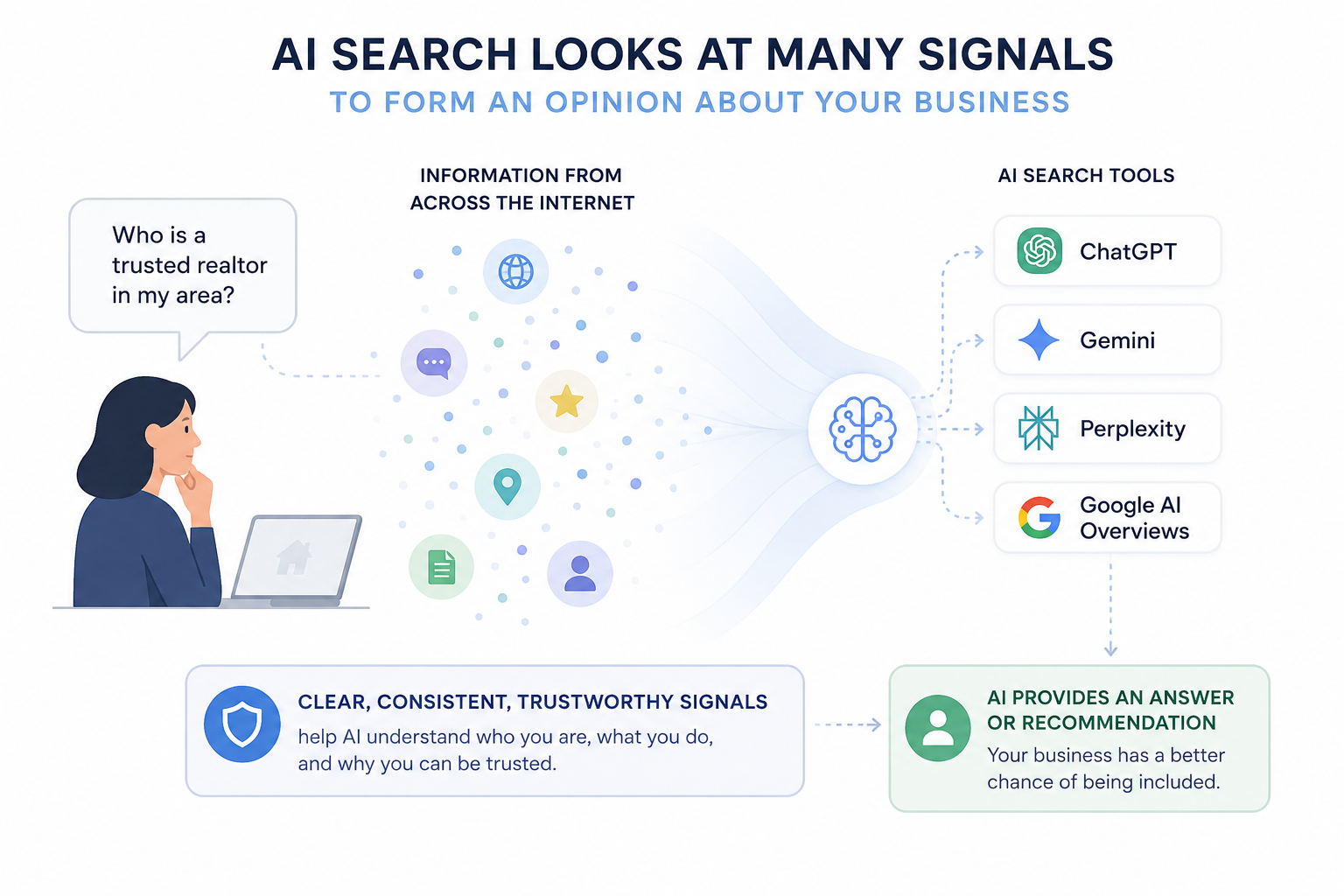
Think of AI search like a research assistant.
If someone asked a research assistant to find a trustworthy realtor, what would that assistant look for?
They would probably look at the realtor’s website, Google Business Profile, reviews, social profiles, local mentions, directories, content, neighbourhood relevance, brand consistency, and reputation across the internet.
AI tools are not human research assistants, but the general idea is similar.
They need information.
They need clarity.
They need public proof.
If your online presence is thin, outdated, inconsistent, or scattered, there may not be enough clear information for AI tools to confidently understand your business.
For example, a realtor might have strong real-world experience but weak online signals.
Maybe their website is vague.
Maybe their Google Business Profile is incomplete.
Maybe their reviews are strong but not connected to a clear local story.
Maybe their name, brokerage, service area, and specialties appear differently across different websites.
Maybe they have very little content explaining who they help, where they work, or what type of real estate problems they solve.
To a human who already knows the realtor, none of this may matter.
But to AI, public information matters a lot.
AI tools can only work with the signals they can access, interpret, and trust.
Why This Affects Realtors
Real estate is a trust-based business.
People are not just buying a product. They are choosing someone to help them make one of the biggest financial decisions of their life.
That means visibility alone is not enough.
A realtor does not just need to be found. They need to be understood and trusted.
This is where AI search creates both a risk and an opportunity.
The risk is that some strong realtors may become harder to discover if their online presence does not clearly explain their value.
The opportunity is that realtors who build stronger public signals may become easier for AI tools to understand, evaluate, and potentially mention.
This does not replace referrals.
It does not replace relationships.
It does not replace good service.
But it can support all of those things.
When someone hears your name and then asks an AI tool about you, what will it find?
When someone asks for local realtor recommendations, are there enough strong signals connected to your name?
When AI tools compare realtors in your area, does your online presence tell a clear story?
These are the types of questions realtors should be thinking about now.
What Realtors Can Control
The good news is that realtors are not powerless.
You cannot control exactly what an AI tool says.
You cannot control every search result.
You cannot control every competitor.
But you can control many of the signals connected to your own business.
At a high level, realtors can work on making their online presence clearer, more consistent, and more trustworthy.
That includes the way your website presents your expertise.
It includes how your Google Business Profile supports your local presence.
It includes whether your reviews reinforce the type of realtor you want to be known as.
It includes whether your name, business information, service areas, and specialties are consistent across the internet.
It includes whether your content helps explain your knowledge, your market, and your value.
It includes whether your online reputation gives AI tools enough public proof to work with.
The goal is not to trick AI.
The goal is to make your real estate business easier to understand.
That distinction matters.
This is not about chasing hacks or trying to manipulate a platform. It is about building a stronger digital footprint so that when AI tools look across the internet, they find a clear, consistent, credible story about who you are and what you do.
AI Visibility Is a Long-Term Strategy
Realtors should not think of AI search as a one-time task.
It is not something you fix in one afternoon.
It is more like building a reputation.
Every improvement adds another signal.
One update to your website may not change everything overnight. One review may not move the needle immediately. One local mention may not suddenly make AI tools recommend you.
But over time, these signals can compound.
Your website, reviews, local presence, directories, content, and reputation can start to support the same story. The more aligned your public information becomes, the easier it is for both people and AI tools to understand your business.
That is why realtors should start thinking about AI search now.
Not because the entire industry will change overnight.
But because online trust takes time to build.
The realtors who wait until AI search is already a major part of consumer behaviour may find themselves playing catch-up.
The realtors who start now can begin strengthening their foundation before the market becomes more crowded.
The Big Picture
AI search is not the end of real estate marketing.
It is the next layer.
Your website still matters.
Your Google Business Profile still matters.
Your reviews still matter.
Your local reputation still matters.
Your content still matters.
Your brand still matters.
But now, all of these pieces may also influence how AI tools understand and describe your business.
That is why realtors need to start thinking beyond traditional SEO and basic online marketing.
The new question is not only:
“Can people find me online?”
The better question is:
“Can AI tools understand, trust, and recommend me based on the public signals connected to my business?”
That is where the future of realtor visibility is heading.
Start Strengthening Your AI Visibility
The AI Search Playbook for Realtors was created to help realtors understand the rules of this new game.
It does not promise guaranteed AI recommendations. No honest system can do that.
But it does show you what to look for, where to improve, and how to strengthen the visibility signals you can control.
If you want your real estate business to have a better chance of being discovered, understood, trusted, and recommended in the AI search era, now is the time to start building those signals.
AI search is still evolving.
But the direction is clear.
Realtors who build a stronger, clearer, more trustworthy online presence today will be better positioned for how people search tomorrow.