

Why AI May Not Recommend You Even If You Are a Great Realtor
You can be a great realtor and still be hard for AI to understand.
That may sound strange at first.
After all, if you have years of experience, happy clients, strong referrals, and good local knowledge, shouldn’t AI tools be able to recognize that?
Not automatically.
AI tools like ChatGPT, Gemini, Perplexity, Grok, and Google AI results do not personally know you. They do not see the private conversations you have with clients. They do not know how carefully you handle negotiations, how much time you spend preparing listings, how well you guide first-time buyers, or how many people in your community trust you.
They can only work with the public information they can find, interpret, and trust.
That is why a realtor can be excellent in real life, but still not show up clearly when someone asks an AI tool for help choosing a real estate agent.
This is one of the most important things realtors need to understand about AI search.
Being good at your job matters.
But being visible, consistent, and understandable online also matters.
AI Does Not Know What Your Clients Know
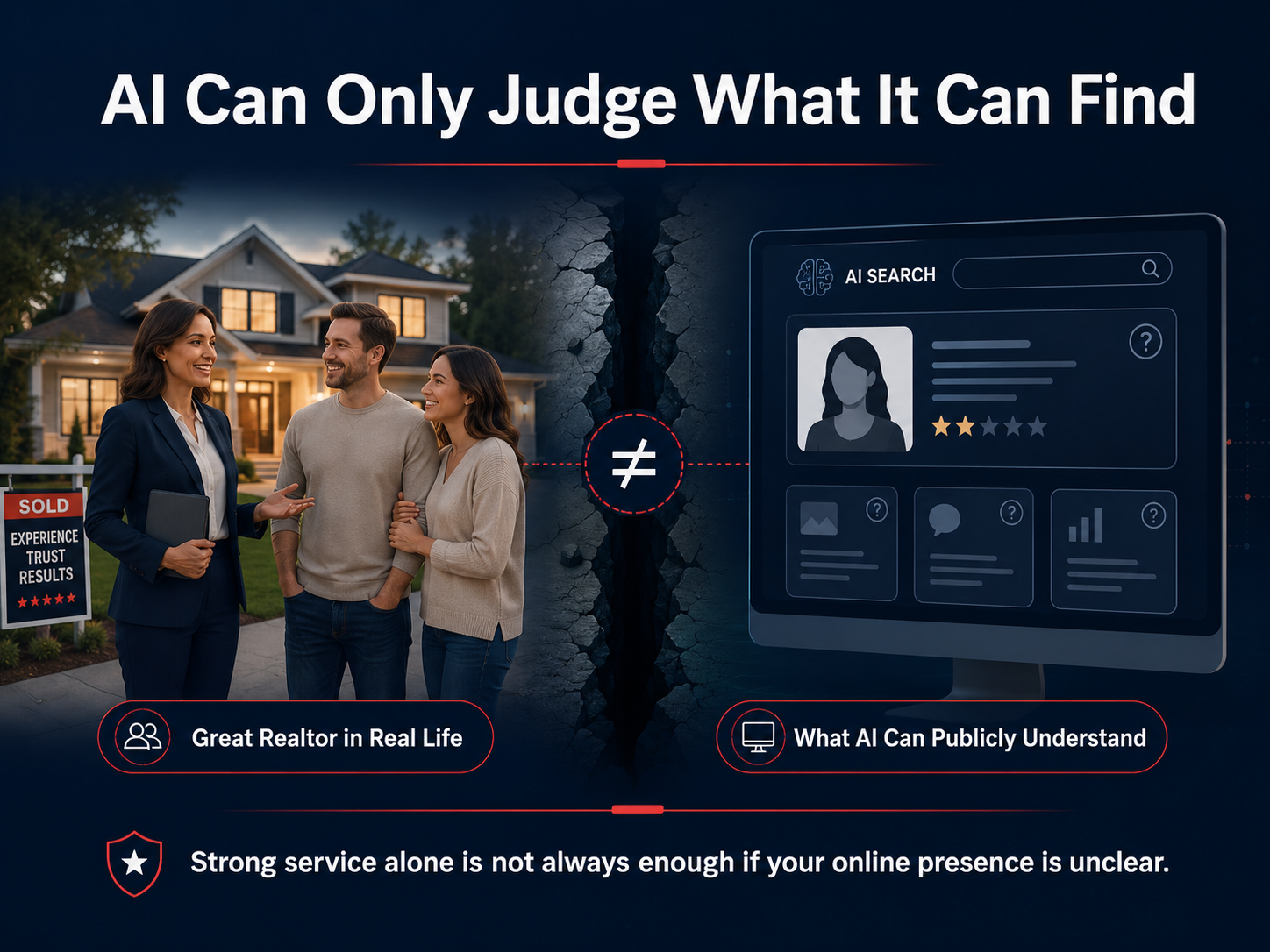
Your past clients may know exactly why you are good.
They know you answered their calls.
They know you explained the process clearly.
They know you helped them avoid mistakes.
They know you were calm during negotiations.
They know you understood their neighbourhood, their goals, and their concerns.
But unless those strengths are reflected somewhere online, AI tools may not be able to see them.
That creates a gap.
In the real world, your reputation may be strong. In the online world, your reputation may not be as clear.
That does not mean you have a bad online presence. It may simply mean your strengths are not being communicated in a way that search engines and AI tools can easily understand.
A human referral can fill in the blanks.
AI cannot always do that.
If someone says to a friend, “You should call Sarah, she is amazing with downsizers,” that friend understands the recommendation.
But if someone asks an AI tool, “Who is a good realtor for downsizing in my area?” the tool has to rely on available public signals.
Can it find clear information that connects that realtor to downsizing?
Can it find reviews that support that reputation?
Can it find pages, mentions, profiles, or content that reinforce the same story?
If not, the AI tool may choose someone else — not because that person is better, but because their online signals are easier to understand.
The Gap Between Reputation and Visibility
Many realtors have a strong real-world reputation but a weaker digital footprint.
This is common.
A realtor may have built their business through referrals, repeat clients, personal relationships, community involvement, and years of consistent service. That is valuable.
But AI search introduces a different kind of visibility challenge.
The question is no longer only:
“Do people in my community know me?”
The question is also:
“Can AI tools understand who I am and why I should be trusted?”
Those are not always the same thing.
A realtor might be well known offline, but online their presence may be scattered, incomplete, outdated, or unclear.
Their website may say very little about their actual expertise.
Their reviews may be strong, but not connected to a clear service area or specialty.
Their profiles across different platforms may not tell the same story.
Their local authority may exist in the real world, but not be reflected clearly across the internet.
Their content may be too generic to help AI understand what makes them different.
This is the visibility gap.
It is not a talent gap.
It is not a service gap.
It is an information gap.
And in the AI search era, information gaps matter.
AI Search Relies on Public Signals
AI tools need signals.
They need information they can gather, compare, summarize, and evaluate.
That information may come from many different places across the internet. It may include your website, business profiles, reviews, local mentions, directories, content, social profiles, and other public references connected to your name and business.
No single signal tells the whole story.
But together, these signals can help AI tools form a clearer picture.
That is why consistency matters.
If your online presence tells one clear story, it becomes easier to understand.
If your online presence tells five different stories, it becomes harder to trust.
For example, imagine a realtor wants to be known as a strong listing agent in a specific city.
But their website is vague.
Their bio is generic.
Their online profiles use different wording.
Their reviews are positive but do not clearly reinforce that positioning.
Their content does not discuss the local market.
Their name and service area appear inconsistently across platforms.
In that case, AI tools may not have a strong enough public pattern to understand what that realtor should be known for.
Now compare that to a realtor whose online presence is clear, consistent, and reinforced across multiple places.
It becomes much easier for both people and AI tools to understand the business.
That does not guarantee a recommendation.
But it does give AI more useful information to work with.
Why Being “Good” Is Not Always Enough
This may be frustrating for realtors who have spent years building their business the right way.
A good realtor may think:
“I already have happy clients.”
“I already get referrals.”
“I already have experience.”
“I already know my market.”
“I already provide excellent service.”
All of that is important.
But AI search does not judge your business the same way a past client does.
A past client can speak from experience.
AI tools rely on public evidence.
If your best qualities are mostly invisible online, AI may not fully understand them.
This is where many good realtors can lose ground to competitors who may not necessarily be better, but who have a clearer online presence.
That is an uncomfortable truth.
The best realtor does not always have the strongest digital footprint.
The most experienced realtor does not always have the clearest online authority.
The most trusted realtor in real life is not always the easiest realtor for AI tools to identify.
This is why realtors need to stop thinking of online presence as just “marketing.”
It is also a public record of trust.
Buyers and Sellers Are Asking Better Questions
Another reason this matters is that people are asking more detailed questions.
In the past, someone might have searched:
“realtor near me”
“Kelowna realtor”
“best real estate agent”
Those searches still happen.
But AI tools make it easier for people to ask more specific questions, such as:
“Who is a good realtor for selling a family home?”
“Which realtor has strong reviews in my area?”
“What should I look for in a listing agent?”
“Can you recommend a realtor who understands investment properties?”
“Who are some trusted realtors for first-time buyers?”
These are not just visibility searches.
They are trust searches.
The user is not only looking for a name. They are looking for confidence.
That is why AI search may become important in real estate.
When people are making a high-trust decision, they often want guidance. AI tools are designed to provide that kind of guidance by summarizing information and helping users compare options.
If your business is not clearly represented online, you may be left out of those conversations.
Not because you are not qualified.
But because AI may not have enough clear public proof to include you.
The Problem With Generic Online Marketing
Many realtor websites and profiles sound very similar.
They often use phrases like:
“Dedicated professional”
“Client-focused service”
“Your trusted real estate expert”
“Helping buyers and sellers achieve their goals”
There is nothing wrong with those phrases, but they are generic.
They do not always help AI tools understand what makes one realtor different from another.
If every realtor says they are experienced, professional, and client-focused, the wording does not create much distinction.
AI tools need clearer context.
What areas do you serve?
Who do you help?
What are you known for?
What type of real estate knowledge do you have?
What do clients consistently say about you?
What public information supports your reputation?
The more generic your online presence is, the harder it may be for AI tools to understand your specific value.
That does not mean your website needs to reveal everything.
It does not mean you need to publish your entire business strategy online.
But it does mean your public presence should give people and AI tools enough clarity to understand your business.
What Realtors Can Control
The good news is that realtors can improve many of the signals connected to their business.
You cannot control exactly what ChatGPT, Gemini, Perplexity, Grok, or Google AI results will say.
You cannot force an AI platform to recommend you.
You cannot guarantee that you will appear in every answer.
But you can improve the public information that exists about your business.
At a high level, realtors can work on making their online presence clearer, more consistent, and more trustworthy.
That means thinking carefully about how your business is described online.
It means making sure your local presence is easy to understand.
It means building a stronger connection between your reputation, your website, your reviews, your content, and your public profiles.
It means reducing confusion.
It means helping AI tools find a consistent story about who you are, what you do, where you work, and why people trust you.
This is not about tricking AI.
It is not about shortcuts.
It is not about trying to game the system.
It is about making your real estate business easier to understand.
That is the real opportunity.
AI Visibility Builds Over Time
AI visibility is not a one-day project.
It is not something you fix once and forget about.
It is more like building a reputation layer across the internet.
Every improvement can add another signal.
Every clear piece of public information can support the larger picture.
Every consistent mention can reduce confusion.
Every strong review can reinforce trust.
Every helpful piece of content can make your expertise easier to understand.
One change may not produce immediate results.
But over time, these signals can compound.
This is why realtors should start before AI search becomes even more competitive.
The realtors who wait may have to catch up later.
The realtors who start now can begin building a stronger foundation.
The Main Lesson
The main lesson is simple:
Being a great realtor is not enough if AI cannot understand why you are great.
Your clients may know.
Your friends may know.
Your referral network may know.
But AI tools need public signals.
They need clarity.
They need consistency.
They need enough trustworthy information to understand your business.
That is why AI search matters for realtors.
It is not replacing relationships.
It is not replacing referrals.
It is not replacing good service.
But it may influence how future buyers and sellers discover, evaluate, and compare realtors online.
If your online presence does not clearly communicate your value, AI may not recommend you — even if you are excellent at what you do.
Start Building a Clearer AI Presence
The AI Search Playbook for Realtors was created to help realtors understand this new visibility challenge.
It does not promise guaranteed recommendations from AI tools. No honest system can do that.
But it does show you what to look for, where to improve, and how to strengthen the online signals you can control.
If you want your business to have a better chance of being discovered, understood, trusted, and recommended in the AI search era, now is the time to start preparing.
Because AI cannot recommend what it does not understand.
And it cannot fully understand what it cannot clearly find.